€ 49,19
WARNINGS
The tablets have a neutral taste. For both animal species, in order to achieve effective control of gastrointestinal nematodes, cestodes, and giardiasis in dogs, treatment should be based on the results of the parasitological examination of feces. Unnecessary use of antiparasitics or use contrary to the instructions provided in this summary of product characteristics may increase the selection pressure for resistance and may reduce effectiveness. The decision to use the veterinary medicine should be based on confirmation of the parasitic species and the parasitic load, or on the risk of infestation based on epidemiological characteristics for each individual animal. Care should be taken to avoid the following practices that may increase the risk of developing resistance and could ultimately result in ineffective therapy: too frequent and repeated use of anthelmintics of the same class for an extended period; underdosing of the veterinary medicine, which may be due to an underestimation of the animal’s body weight, incorrect administration of the veterinary medicine, or loss of calibration of the dispenser. It is also recommended to verify the success of the treatment (for example, by checking clinical appearance and egg count in feces). Clinical cases of suspected resistance to anthelmintics should be further examined using appropriate methods (for example, the fecal egg count reduction test (FECRT)). Where the results of diagnostic methods clearly indicate resistance to a particular anthelmintic, an anthelmintic belonging to another pharmacological class and having a different mechanism of action should be used. Special precautions for safe use in the target species: consideration should be given to the possibility that other cohabiting animals may be a source of reinfestation by gastrointestinal nematodes, and these should be treated, as necessary, with an appropriate veterinary medicine. Special precautions to be taken by the person administering the veterinary medicine to the animals: wash hands after use. Do not eat, drink, or smoke during administration. This veterinary medicine may be toxic if ingested by humans. This veterinary medicine may cause hypersensitivity reactions. Avoid contact with skin, eyes, and mucous membranes. Always wear protective gloves while handling the veterinary medicine. In case of contact with skin and/or eyes, rinse immediately with plenty of water. Remove contaminated clothing. Special precautions for environmental protection: not applicable. Data not available. Incompatibilities: none noted.
PHARMACOLOGICAL CATEGORY
Anthelmintics.
STORAGE
Panacur 250 mg tablets: this veterinary medicine does not require any special storage conditions. Panacur forte 500 mg tablets: do not store above 25 degrees C. Shelf life of the veterinary medicine packaged for sale: 3 years.
CONTRAINDICATIONS/ADVERSE EFFECTS
Do not use in cases of hypersensitivity to the active substance or to any of the excipients.
NAME
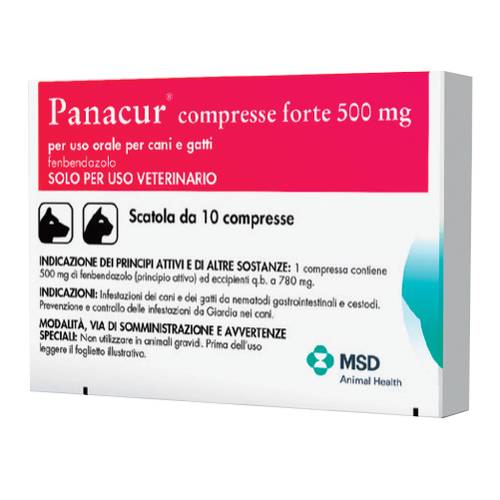
PANACUR TABLETS FOR DOGS AND CATS
DIAGNOSIS AND PRESCRIPTION
Veterinary medicine not subject to prescription.
EXCIPIENTS
Monohydrate lactose, corn starch, anhydrous colloidal silica, hydroxyethyl cellulose, sodium starch glycolate (type A), magnesium stearate.
ADVERSE EFFECTS
Dogs. Rare (from 1 to 10 animals out of 10,000 treated): gastrointestinal disturbances (e.g. vomiting and diarrhea ^1); very rare (< 1 animal/10,000 treated animals, including isolated reports): allergic reaction. ^1 Usually, diarrhea is mild. Cats. Very rare (< 1 animal/10,000 treated animals, including isolated reports): gastrointestinal disturbances (e.g. vomiting and diarrhea ^1). ^1 Usually, diarrhea is mild. Reporting adverse events is important as it allows for continuous monitoring of the safety of a veterinary medicine. Reports should be sent, preferably through a veterinarian, to the marketing authorization holder or their local representative or the competent national authority via the national reporting system. See also the package leaflet for respective contacts.
PREGNANCY AND LACTATION
Do not use in pregnant animals. In the absence of studies in the target species, during lactation use only according to the risk-benefit assessment of the responsible veterinarian.
INDICATIONS
Dogs. Treatment of the following infestations by gastrointestinal nematodes and cestodes: ascarids (Toxocara canis, Toxascaris leonina), mature stages; hookworms (Ancylostoma caninum, Uncinaria stenocephala), mature stages; whipworms (Trichuris vulpis), mature stages; cestodes (Taenia pisiformis), mature stages. Prevention and control of Giardia infestations. Cats. Treatment of infestations by gastrointestinal nematodes and cestodes: ascarids (Toxocara cati), mature stages; hookworms (Ancylostoma tubaeforme), immature and mature stages; cestodes (Taenia hydatigena), mature stages. It is advisable to repeat treatment for ascarids and cestodes considering the life cycle of the parasite from larva to mature stage.
INTERACTIONS
None noted.
DOSAGE
Oral use. The dosage for dogs and cats is 50 mg of fenbendazole/kg of body weight/day. Panacur 250 mg tablets: 1/2 tablet (= 125 mg of fenbendazole) for 2.5 kg of body weight; 1 tablet (= 250 mg of fenbendazole) for 5 kg of body weight. Panacur forte 500 mg tablets: 1/2 tablet (= 250 mg of fenbendazole) for 5 kg of body weight; 1 tablet (= 500 mg of fenbendazole) for 10 kg of body weight. Treatment should be repeated for 3 consecutive days. Dogs: crumble the tablets and mix them with food. It is also possible to dissolve the tablets in a little water and mix everything with food. Cats: dissolve the tablets in a little water and mix them with food. It is advisable to administer the tablets mixed with an initial part of the daily food ration, to ensure their complete intake. Administration of the tablets as is or dissolved in water to fasting animals is not recommended to avoid a possible decrease in effectiveness. Avoid administering milk simultaneously. Underdosing may lead to a lack of effectiveness and may promote the development of resistance. To ensure correct dosing, determine body weight as accurately as possible.
ACTIVE INGREDIENTS
Each 250 mg and 500 mg tablet contains the active substance: fenbendazole 250 mg; fenbendazole 500 mg.
SAFETY IN TARGET SPECIES
Data not available.
TARGET SPECIES
Dog, cat (adults and puppies).
WITHDRAWAL TIME
Not applicable.
ADMINISTRATION/ROUTE OF ADMINISTRATION
Oral.
€ 49,19
WARNINGS
The tablets have a neutral taste. For both animal species, in order to achieve effective control of gastrointestinal nematodes, cestodes, and giardiasis in dogs, treatment should be based on the results of the parasitological examination of feces. Unnecessary use of antiparasitics or use contrary to the instructions provided in this summary of product characteristics may increase the selection pressure for resistance and may reduce effectiveness. The decision to use the veterinary medicine should be based on confirmation of the parasitic species and the parasitic load, or on the risk of infestation based on epidemiological characteristics for each individual animal. Care should be taken to avoid the following practices that may increase the risk of developing resistance and could ultimately result in ineffective therapy: too frequent and repeated use of anthelmintics of the same class for an extended period; underdosing of the veterinary medicine, which may be due to an underestimation of the animal’s body weight, incorrect administration of the veterinary medicine, or loss of calibration of the dispenser. It is also recommended to verify the success of the treatment (for example, by checking clinical appearance and egg count in feces). Clinical cases of suspected resistance to anthelmintics should be further examined using appropriate methods (for example, the fecal egg count reduction test (FECRT)). Where the results of diagnostic methods clearly indicate resistance to a particular anthelmintic, an anthelmintic belonging to another pharmacological class and having a different mechanism of action should be used. Special precautions for safe use in the target species: consideration should be given to the possibility that other cohabiting animals may be a source of reinfestation by gastrointestinal nematodes, and these should be treated, as necessary, with an appropriate veterinary medicine. Special precautions to be taken by the person administering the veterinary medicine to the animals: wash hands after use. Do not eat, drink, or smoke during administration. This veterinary medicine may be toxic if ingested by humans. This veterinary medicine may cause hypersensitivity reactions. Avoid contact with skin, eyes, and mucous membranes. Always wear protective gloves while handling the veterinary medicine. In case of contact with skin and/or eyes, rinse immediately with plenty of water. Remove contaminated clothing. Special precautions for environmental protection: not applicable. Data not available. Incompatibilities: none noted.
PHARMACOLOGICAL CATEGORY
Anthelmintics.
STORAGE
Panacur 250 mg tablets: this veterinary medicine does not require any special storage conditions. Panacur forte 500 mg tablets: do not store above 25 degrees C. Shelf life of the veterinary medicine packaged for sale: 3 years.
CONTRAINDICATIONS/ADVERSE EFFECTS
Do not use in cases of hypersensitivity to the active substance or to any of the excipients.
NAME
PANACUR TABLETS FOR DOGS AND CATS
DIAGNOSIS AND PRESCRIPTION
Veterinary medicine not subject to prescription.
EXCIPIENTS
Monohydrate lactose, corn starch, anhydrous colloidal silica, hydroxyethyl cellulose, sodium starch glycolate (type A), magnesium stearate.
ADVERSE EFFECTS
Dogs. Rare (from 1 to 10 animals out of 10,000 treated): gastrointestinal disturbances (e.g. vomiting and diarrhea ^1); very rare (< 1 animal/10,000 treated animals, including isolated reports): allergic reaction. ^1 Usually, diarrhea is mild. Cats. Very rare (< 1 animal/10,000 treated animals, including isolated reports): gastrointestinal disturbances (e.g. vomiting and diarrhea ^1). ^1 Usually, diarrhea is mild. Reporting adverse events is important as it allows for continuous monitoring of the safety of a veterinary medicine. Reports should be sent, preferably through a veterinarian, to the marketing authorization holder or their local representative or the competent national authority via the national reporting system. See also the package leaflet for respective contacts.
PREGNANCY AND LACTATION
Do not use in pregnant animals. In the absence of studies in the target species, during lactation use only according to the risk-benefit assessment of the responsible veterinarian.
INDICATIONS
Dogs. Treatment of the following infestations by gastrointestinal nematodes and cestodes: ascarids (Toxocara canis, Toxascaris leonina), mature stages; hookworms (Ancylostoma caninum, Uncinaria stenocephala), mature stages; whipworms (Trichuris vulpis), mature stages; cestodes (Taenia pisiformis), mature stages. Prevention and control of Giardia infestations. Cats. Treatment of infestations by gastrointestinal nematodes and cestodes: ascarids (Toxocara cati), mature stages; hookworms (Ancylostoma tubaeforme), immature and mature stages; cestodes (Taenia hydatigena), mature stages. It is advisable to repeat treatment for ascarids and cestodes considering the life cycle of the parasite from larva to mature stage.
INTERACTIONS
None noted.
DOSAGE
Oral use. The dosage for dogs and cats is 50 mg of fenbendazole/kg of body weight/day. Panacur 250 mg tablets: 1/2 tablet (= 125 mg of fenbendazole) for 2.5 kg of body weight; 1 tablet (= 250 mg of fenbendazole) for 5 kg of body weight. Panacur forte 500 mg tablets: 1/2 tablet (= 250 mg of fenbendazole) for 5 kg of body weight; 1 tablet (= 500 mg of fenbendazole) for 10 kg of body weight. Treatment should be repeated for 3 consecutive days. Dogs: crumble the tablets and mix them with food. It is also possible to dissolve the tablets in a little water and mix everything with food. Cats: dissolve the tablets in a little water and mix them with food. It is advisable to administer the tablets mixed with an initial part of the daily food ration, to ensure their complete intake. Administration of the tablets as is or dissolved in water to fasting animals is not recommended to avoid a possible decrease in effectiveness. Avoid administering milk simultaneously. Underdosing may lead to a lack of effectiveness and may promote the development of resistance. To ensure correct dosing, determine body weight as accurately as possible.
ACTIVE INGREDIENTS
Each 250 mg and 500 mg tablet contains the active substance: fenbendazole 250 mg; fenbendazole 500 mg.
SAFETY IN TARGET SPECIES
Data not available.
TARGET SPECIES
Dog, cat (adults and puppies).
WITHDRAWAL TIME
Not applicable.
ADMINISTRATION/ROUTE OF ADMINISTRATION
Oral.
There are no reviews yet.
Only logged in customers who have purchased this product may leave a review.

You need to be logged in to use the wishlist ❤️
Reviews
There are no reviews yet.
Only logged in customers who have purchased this product may leave a review.